I get a particular kind of phone call a few times a year. An org has gone red. Adoption is close to zero, leadership says Salesforce brings no value, users call it slow, buggy, barely usable — and someone has already priced out Microsoft Dynamics. The standard consulting answer to that call is a discovery workshop, a business-process realignment, a strategy session with management. Many months. Big dollars. Here’s the uncomfortable truth from the orgs I’ve actually rescued: most of the time, the problem was never the strategy. The problem was that Salesforce had become literally unusable — and the fix is triage, not therapy.
What I’ll Cover in This Blog
✔️ The adoption death spiral: how a good org becomes a red one
✔️ Why users and leadership are debating two different problems
✔️ The usability triage: five unglamorous moves that bring adoption back
✔️ Why this works when workshops don’t
✔️ The honest boundary: when it really is a strategy problem
Now, let’s dive in! 🔥
The Scenario
Redstone Building Supplies runs 140 Salesforce users across sales, service, and operations. Three years ago the org was fine. Today: reps log deals in a spreadsheet and paste them in on Friday. The Account page has 90+ fields, 14 of them required, 6 of them nobody can explain. The default list views show every record since 2021. Reports take a coffee break to load because every object drags years of dead data. Two admin generations have left; their half-finished automations still fire errors nobody reads.
Leadership’s diagnosis: “Salesforce doesn’t fit our business anymore. We need a strategy review — or a new CRM.”
The users’ diagnosis, when I actually sat with them: “It takes 11 clicks and two minutes of loading to log one call.”
Those are two different diseases. Only one of them is real.
The Death Spiral: How Orgs Go Red
No org becomes unusable overnight. It happens in a loop, and once you’ve seen it you can’t unsee it:
🔹 Clutter accumulates. Every project adds fields, tabs, record types, validation rules. Nothing is ever removed, because removing things feels risky and nobody owns “less.”
🔹 Friction rises. Pages load slower, forms get longer, the right view is buried under thirty wrong ones. Each individual annoyance is too small to escalate.
🔹 Users route around. Spreadsheets, notes apps, memory. Data entry becomes a Friday chore done from recollection — the shadow-system signature I look for in every adoption audit.
🔹 Data rots. Because entry is grudging and late, the CRM’s answers get stale and wrong.
🔹 Trust dies. Reports disagree with reality, so leadership stops believing them — and starts saying “Salesforce brings no value.”
🔹 The spiral tightens. Less use → worse data → less value → less use. By the time anyone says “Dynamics,” the loop has been running for a year.
Notice what’s absent from that loop: strategy. Nobody in it is confused about what the business does or how leads should flow. They’re just tired of a slow, cluttered tool.
Two Rooms, Two Different Problems
Here’s why the standard playbook misfires. When an org goes red, leadership and users are having completely different conversations — and consultants get hired by the room with the wrong diagnosis.
🔹 In the boardroom, the conversation is abstract: ROI, process alignment, “does Salesforce still fit our operating model,” vendor comparisons. Abstract problems attract abstract solutions — workshops, roadmaps, realignment decks.
🔹 At the desks, the conversation is brutally concrete: the list view with 40 columns, the 14 required fields for a simple call log, the report that times out, the flow error email everyone deletes, the six-second page load, times fifty, times every day.
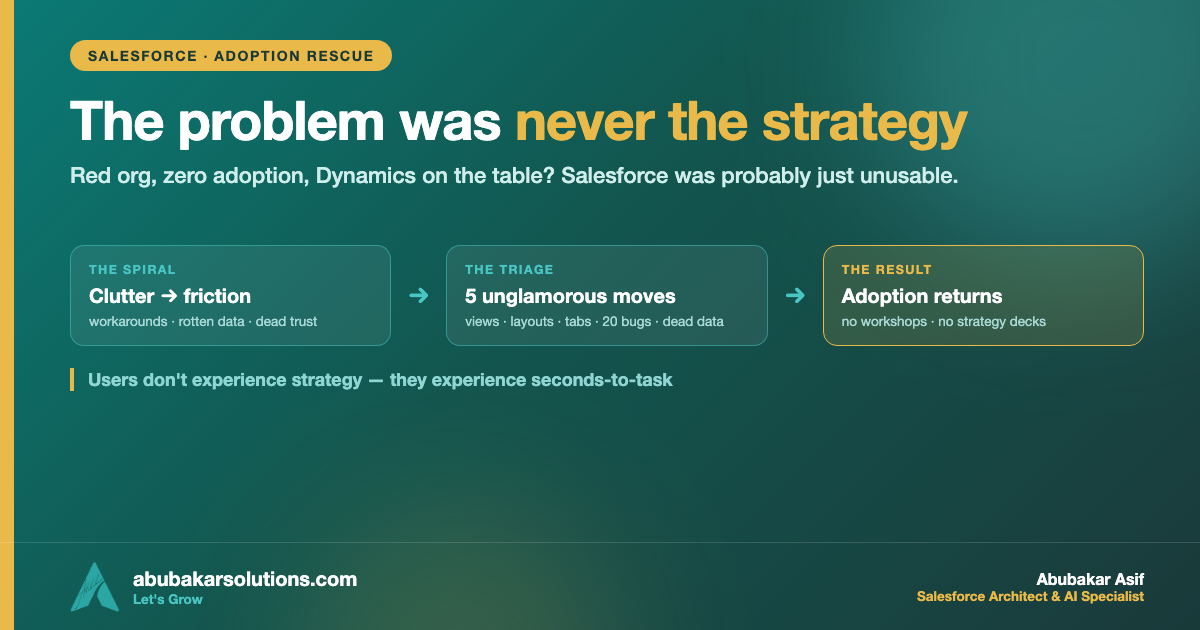
Users don’t experience your CRM strategy. They experience seconds-to-task. When seconds-to-task is bad enough, no strategy on earth will make them log in — and when it’s good, adoption barely needs encouragement. The boardroom conversation is downstream of the desk conversation, not the other way around.
The Usability Triage: Five Unglamorous Moves
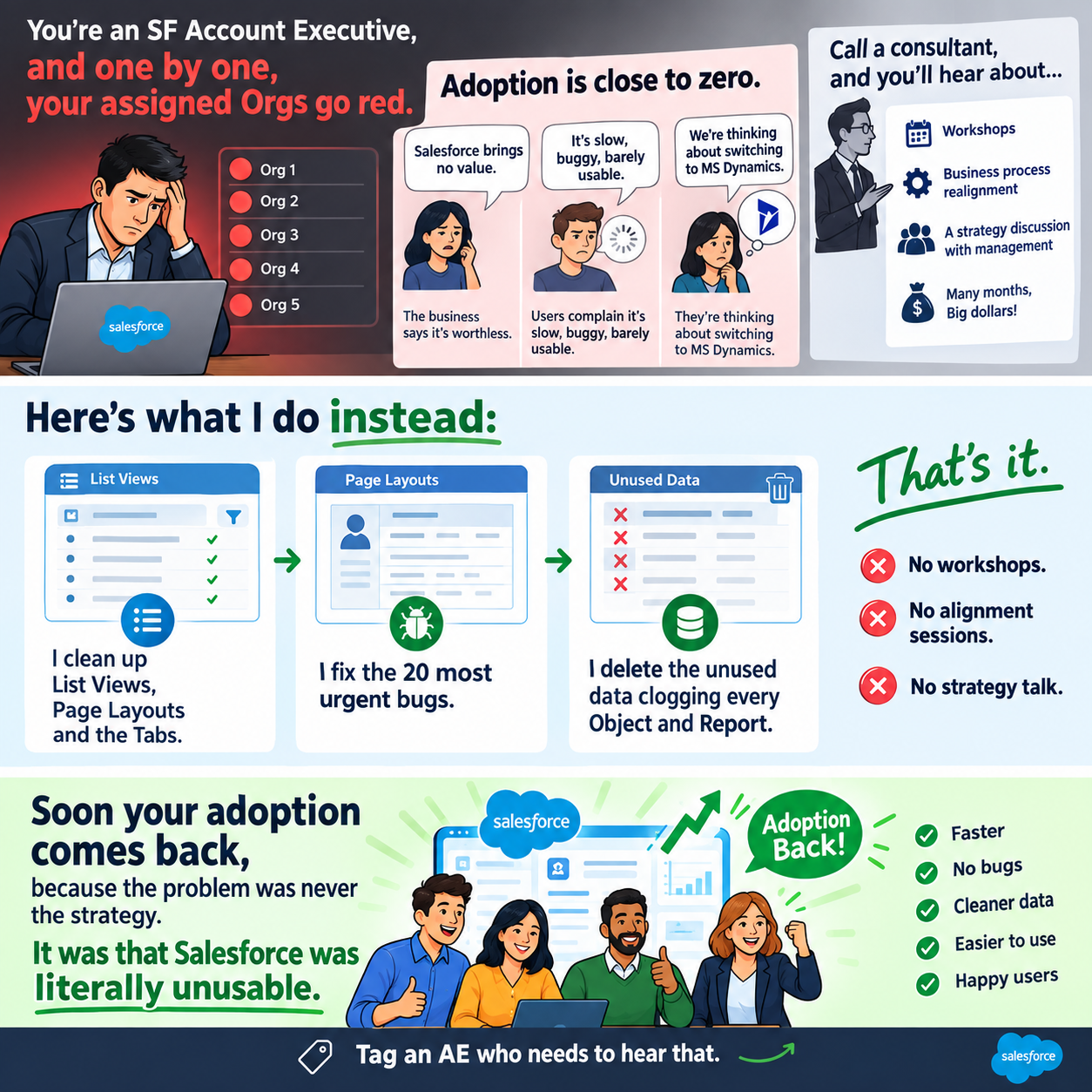
So when I take the red-org call, here’s what I actually do — before any talk of process or platforms:
1️⃣ Clean the List Views. Kill the dead ones, build per-role defaults that answer the question each role actually asks in the morning, cap the columns. This is cosmetic the way a windshield is cosmetic.
2️⃣ Fix the Page Layouts. Audit which fields are actually filled and used; collapse the graveyard below the fold or out entirely; cut the required-field list down to what’s genuinely required. Every field on a page is a small tax on every user, forever.
3️⃣ Prune the Tabs and apps. Each role sees the five things they use — not the nineteen things every project ever added.
4️⃣ Fix the 20 most urgent bugs. Not the backlog. The twenty things users hit daily — collected by asking them, ranked by frequency × friction, fixed in days.
5️⃣ Delete the dead data. The stale records clogging every object, every report, every search result. Archive what compliance needs, remove the rest, and watch reports get fast and truthful again.
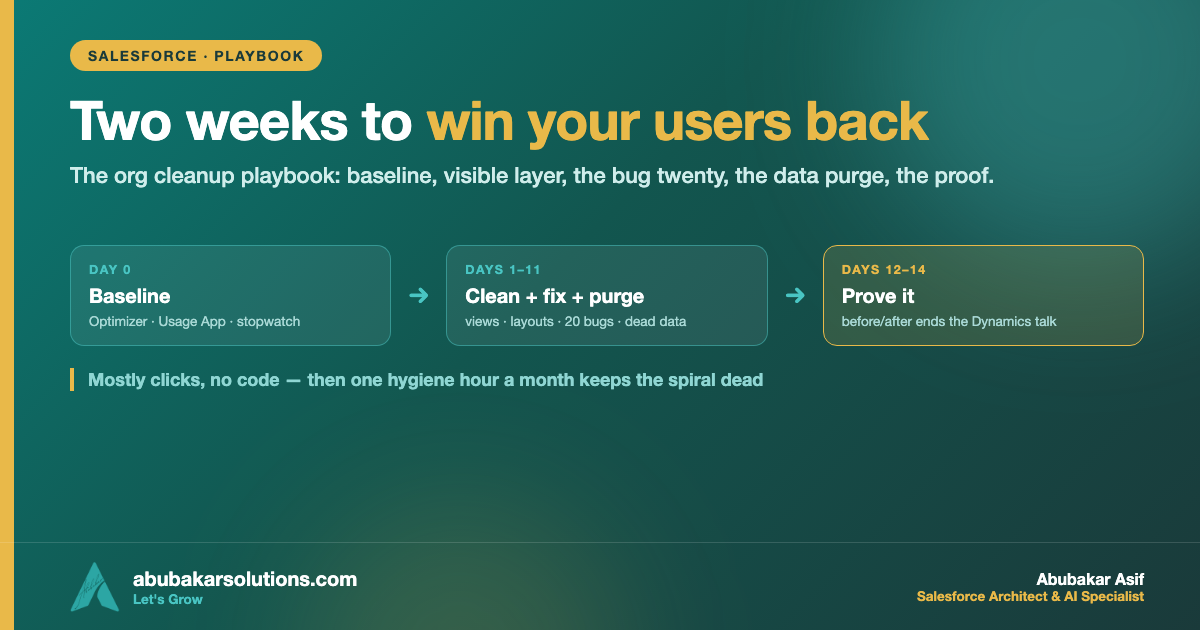
No workshops. No alignment sessions. No strategy talk. Two focused weeks — and I walk through every move, step by step with the exact tools, in part two: The Salesforce Org Cleanup Playbook.
Here’s the whole argument in one picture:
Why Triage Works When Workshops Don’t
The mechanics are worth understanding, because they explain why such unglamorous work moves the needle so fast:
🔹 It attacks the loop at its cheapest joint. You can’t workshop your way out of a feedback loop — you have to break one of its links. Friction is the link you can break in days, not quarters.
🔹 Users feel it immediately. A strategy realignment is invisible to a rep for months. A list view that suddenly answers their morning question is visible tomorrow — and visible improvement is what rebuilds the habit of logging in.
🔹 It restores trust in the fastest currency there is: responsiveness. When the twenty daily bugs get fixed in two weeks after years of neglect, the message users receive isn’t “the org is better.” It’s “someone is finally listening.” That message does more for adoption than any town hall.
🔹 It makes every later conversation honest. Once the org is usable, the data starts flowing again — and now you can actually tell whether there’s a real strategy problem underneath, using numbers you can finally trust. This matters double if AI is on the roadmap: an unusable org produces exactly the rotten data that poisons every AI initiative built on top of it.
Salesforce’s own Well-Architected framework puts it plainly: an intentional, adoptable experience is an architectural concern, not a cosmetic one. Usability is architecture — at the layer users actually touch.
The Honest Boundary: When It Really Is Strategy
I’d be selling you something dishonest if I claimed the triage fixes everything. Sometimes the red org really does have a structural disease: the data model fights the business, departments run on contradictory processes, six tools overlap the CRM, nobody owns anything. That’s when you need the deeper engagement — the interviews, the mapping, the ranked blueprint — and I’ve written that playbook too: The Current State Assessment.
The order is the point. You don’t run a two-week discovery on a patient who’s bleeding out. Triage first — it’s cheap, it’s fast, and it either solves the problem outright or stabilizes the org so a real assessment measures the disease instead of the symptoms. In my experience, a meaningful share of “we need a CRM strategy review” engagements dissolve entirely somewhere around the second week of cleanup — because the strategy was never sick. The list views were.
Conclusion
✔️ Red orgs follow a loop — clutter → friction → workarounds → rotten data → dead trust — and strategy appears nowhere in it.
✔️ Two rooms, two problems: the boardroom debates value narratives while the desks fight 14 required fields and six-second loads.
✔️ The triage is five unglamorous moves: list views, page layouts, tabs, the daily-bug twenty, and the dead data.
✔️ It works because users feel it in days — and “someone is finally listening” rebuilds adoption faster than any roadmap.
✔️ The boundary is real: if the org is still red after it’s genuinely usable, then you have a strategy problem — and now the data to prove it.
✔️ Usable first, strategic second. Always in that order.
Before you price the migration to Dynamics, spend two weeks making the org you already own usable. It’s the cheapest experiment in enterprise software — and it wins more often than any deck.
Got an org going red right now? Tell me the one thing your users complain about most — that’s where the triage starts.
What’s the most absurd required field in your org? Tell me on LinkedIn — I collect these.
About the Author — Abubakar Asif
SALESFORCE ARCHITECT · AI SPECIALIST · CLOUD ARCHITECT · PAKISTAN
Abubakar Asif — Salesforce Solution Architect, AI & Cloud Specialist based in Pakistan
Abubakar Asif is a Salesforce Solution Architect and artificial intelligence, Google Cloud and CRM specialist based in Pakistan — a top-rated AI, cloud infrastructure and Salesforce expert, and a National AI Research Engineer. He began as a core member and AI researcher with Google Developer Group, known for AI-powered brain-state recognition research, then built AI models and the applications around them for STEM education with STEM Wizards Academia, Toronto.
TRUE AI PIONEER · PRE-GENAI ERA
Abubakar is not just an AI adopter — he is a researcher who built models before “AI” became a buzzword. Before ChatGPT, Claude, Grok or Gemini existed, he was training and deploying custom neural networks from mathematical first principles.
A turn toward Salesforce and AI made him a Solution Architect, which opened the rest: CTO at Sunshine AI, where he led the technology and architecture that earned the startup Salesforce Consulting Partner status and drove healthy partner revenue; consultant and lead roles across Australia, Indonesia, the United States and the United Kingdom; and CTO at Shift Financial Planning, building next-generation financial planning powered by AI and Open Banking APIs.
Today he is Chief Technology Officer at Kalala Consulting, leading AI, CRM and cloud architecture — Salesforce, Agentforce, Data 360, Google Cloud and Microsoft Azure — for clients across financial services, healthcare, education and other industries. He writes here at abubakarsolutions.com about Salesforce architecture, Agentforce and AI enablement, Google Cloud, and the data foundations that make all of it work.