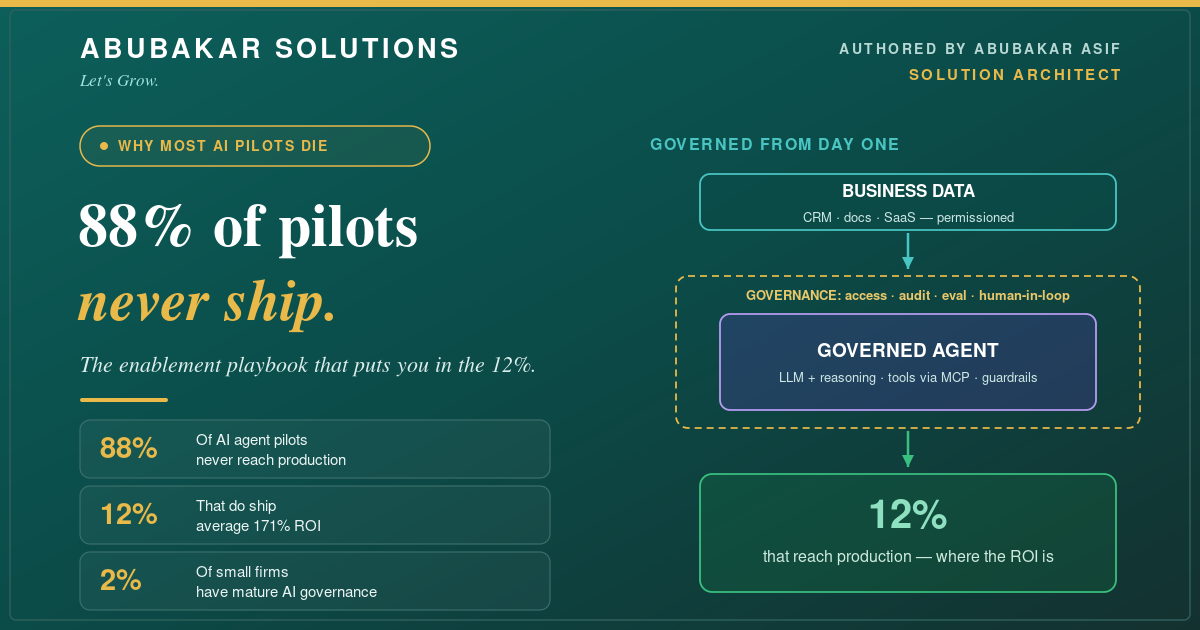
Here is the uncomfortable statistic every founder should sit with before funding an AI project: 88% of AI agent pilots never reach production. That number, from 2026 industry research, isn’t a story about weak models — the models are extraordinary. It’s a story about missing foundations. The pilots that *do* ship return an average of 171% ROI. So the question isn’t “should we do AI?” It’s “how do we build so we land in the 12% that make it?” This post is the enablement playbook I’d hand a small or mid-sized business to do exactly that — no hype, just the architecture and the order of operations.
What I’ll Cover in This Blog
- ✔️ Why most pilots die — and what the 12% do differently
- ✔️ The target architecture — governed from day one, not bolted on later
- ✔️ The enablement path — data foundation, one agent, then scale
- ✔️ What it costs and what it returns — honest ROI math
- ✔️ The pitfalls that quietly kill AI projects
Now, let’s dive in. 🔥
The Scenario
Meet BrightLedger, a 60-person accounting firm. Leadership wants an AI assistant that answers client questions, drafts document requests, and pulls status from their practice-management system. They ran a slick two-week pilot on a demo dataset. Everyone was impressed. Then it stalled — because the demo never touched their real, messy, permissioned data, and nobody could answer “what happens when it’s wrong, and who’s allowed to see what?”
BrightLedger isn’t behind. They’re exactly average. Only 2% of small firms have a mature AI governance framework, and infrastructure and governance gaps — not model quality — are the top two reasons pilots die (41% and 38% of failures respectively). The fix isn’t a better demo. It’s building the boring parts first.
The Target Architecture
The single most important design decision: wrap governance around the agent from day one. Most teams build the agent, get excited, then try to add access control and auditing later — and that’s precisely where projects stall. Here’s the shape I aim for.
- 🔹 The data foundation comes first. An agent grounded in unified, permissioned data is trustworthy; one prompted against a demo file is a party trick. This is the same discipline I use on Salesforce — see how a unified layer changes everything in Salesforce Data Cloud in Action.
- 🔹 MCP is how the agent reaches your systems. The Model Context Protocol — created by Anthropic, now a Linux Foundation standard and supported across Anthropic, Google, Microsoft, Salesforce and Snowflake — means you connect tools once, through an open standard, instead of hand-building brittle integrations. For an SMB, that’s the difference between weeks and months.
- 🔹 Governance is the container, not an afterthought. Access control, audit logs, evaluation, and a human-in-the-loop path wrap the agent from the first commit. Governance is what turns a demo into something you can put in front of clients.
The Enablement Path
Phase 1: The data foundation
- 🔹 What: Pick the *one* workflow with the clearest ROI and connect only the data it needs — permissioned, retrieval-ready. Resist the urge to “ingest everything.”
- 🔹 Why: Infrastructure gaps cause 41% of pilot failures. A narrow, clean foundation beats a broad, messy one every time.
- 🔹 Watch: Identity and permissions belong *in* the data layer, so the agent physically cannot surface what a given user shouldn’t see.
Phase 2: One governed agent
- 🔹 What: Ship a single agent for that one workflow, with explicit tools (via MCP), guardrails, an evaluation set, and a clean escalation to a human.
- 🔹 Why: A narrow agent you can fully reason about earns trust; a broad one erodes it. This mirrors how I’d deploy an Agentforce agent step by step — scope tight, prove it, then widen.
- 🔹 How: Write an evaluation set *before* launch — real questions with known-good answers — so “is it working?” becomes a number, not a vibe. ROI-measurement failure sinks a third of pilots; measurement is a Phase-2 deliverable, not a Phase-5 hope.
Phase 3: Scale with governance
- 🔹 What: Add workflows and tools, expand access carefully, and keep every action observable.
- 🔹 Why: Gartner projects over 40% of agentic AI projects will be cancelled by 2027 on runaway cost and weak controls. Governance is what keeps you off that list.
- 🔹 How: Review the audit trail and eval scores on a cadence. Retire tools the agent doesn’t use. Treat the agent like a junior team member whose work you spot-check — because that’s exactly what it is.
What This Costs / What It Returns
- 🔹 Costs are mostly consumption now. Whether you build on Agentforce (~$0.10 per action or $2 per conversation), a cloud AI platform, or an open stack, you largely pay per use — which is friendly to SMB budgets because cost tracks value.
- 🔹 The foundation is the real investment. Expect the data and governance work to be the bulk of Phase 1 effort. That’s not overhead; that’s the reason you’ll be in the 12%.
- 🔹 The return is documented. Production agents average ~171% ROI. But that number belongs only to teams that *shipped* — and shipping is a governance story, not a model story.
Common Pitfalls
- ✔️ Demo-data syndrome. If your pilot never touched real, permissioned data, you haven’t tested the hard part. Start there.
- ✔️ Governance-later. Bolting on access control and audit after the fact is the single most common reason projects stall. Wrap it from day one.
- ✔️ No evaluation set. Without known-good answers, you can’t prove value — and unproven projects get cancelled.
- ✔️ Boiling the ocean. One workflow, done fully, beats ten half-built ones.
- ✔️ Custom-integrating everything. Reach systems through MCP where you can; every bespoke connector is future maintenance you’ll regret.
Conclusion
The gap between an impressive demo and a shipped agent is almost never the model — it’s the foundation underneath and the governance around it. Here’s the whole playbook:
- ✔️ Data foundation first — one workflow, real permissioned data, not a demo file.
- ✔️ One governed agent — explicit tools via MCP, guardrails, and an evaluation set from day one.
- ✔️ Scale with governance — so the project never becomes a cancellation statistic.
Do it in that order and you’re not gambling on AI — you’re engineering it. Start with one workflow and the boring parts first; that discipline is the whole difference between the 88% and the 12%.
If you want help designing your AI enablement roadmap — data foundation, first agent, governance — that’s the work I do; let’s map it to your business.
Where is your AI project stuck — data, governance, or proving ROI? Tell me in the comments.