Every service leader I talk to has the same quiet problem. The backlog never really clears. Agents copy-paste the same three answers all day, the genuinely hard cases wait behind the easy ones, and “24/7 support” means a chatbot that hands off the moment a customer asks anything real. Deflection is no longer a nice-to-have — it’s the difference between a team that scales and one that drowns. In this post I will walk you through how I would architect a service org on Agentforce 360 so that an agent resolves the routine cases autonomously, grounded in *live* data, and escalates only what genuinely needs a human.
What I’ll Cover in This Blog
- ✔️ The scenario — a realistic service org and why its deflection stalls
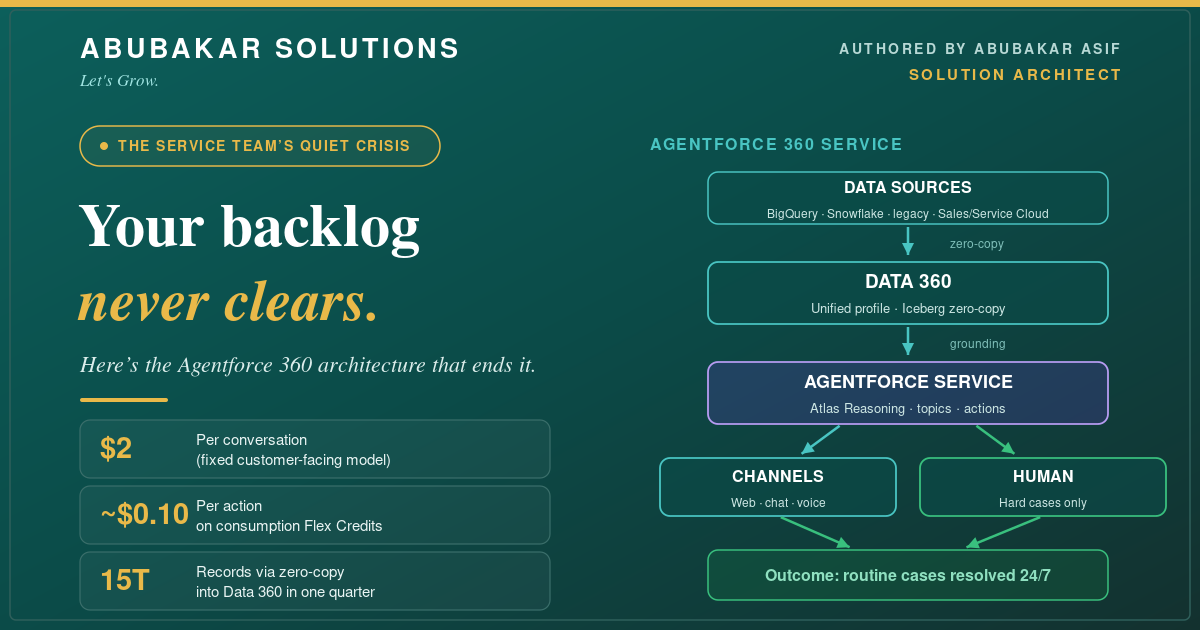
- ✔️ The target architecture — Data 360, the Atlas Reasoning Engine, and channels
- ✔️ The enablement path — three phases, from data foundation to governed autonomy
- ✔️ What it costs and what it returns — Flex Credits, per-conversation, and honest math
- ✔️ The pitfalls I watch for — latency, grounding gaps, and runaway actions
Now, let’s dive in. 🔥
The Scenario
Picture a mid-market subscription business — call it NorthPeak — with ~250,000 customers and a 40-person support team. Billing lives in one system, product entitlements in another, order history in a legacy database, and CRM in Salesforce. When a customer asks “why was I charged twice and when does my plan renew?”, the answer spans three systems no single agent can see at once. Average handle time creeps up, first-contact resolution drops, and the backlog grows every Monday.
NorthPeak doesn’t need another chatbot. It needs an agent that can *reason over the same data a human would* and take action — and it needs that without a year-long data migration.
The Target Architecture
The centerpiece is simple to say and hard to earn: ground the agent in unified, live data, then let it act. In the current stack (rebranded at Dreamforce 2025), Data Cloud is now “Data 360” and the platform is “Agentforce 360.” Data 360 unifies the customer across systems — and critically, it can do so zero-copy, reading external tables in place rather than duplicating them.
- 🔹 Data 360 is the grounding layer, not just a database. Its job is to give the agent one unified view of the customer. With zero-copy connectors it can read billing from BigQuery or Snowflake *in place* — Salesforce reports roughly 15 trillion records flowed through zero-copy connectors in a single recent quarter, so this is a mainstream pattern now, not an edge case.
- 🔹 The Atlas Reasoning Engine is what makes it “agentic.” It queries Data Model Objects through auto-launched Flows, grounding every response in live enterprise data before it answers or acts. This is the difference between a bot that guesses and an agent that *knows*.
- 🔹 Channels and escalation are first-class. The same agent serves web, in-app, messaging, and voice — and the design goal is not 100% deflection, it’s routing the hard cases to humans cleanly, with full context attached.
The Enablement Path
I never deploy an autonomous agent on day one. I earn autonomy in three phases.
Phase 1: The data foundation
- 🔹 What: Stand up Data 360 and connect the systems that answer the top 20 questions — usually billing, entitlements, and order history. Where the data already lives in a lakehouse, use zero-copy so you’re not building yet another sync.
- 🔹 Why: An agent is only as trustworthy as its grounding. Get identity resolution and the unified profile right first; everything else compounds on it.
- 🔹 Watch: Zero-copy is superb for reach, but it federates queries to the source. For data an agent needs *mid-conversation* at sub-200ms latency, materialize a fast copy instead — reach and latency are different design goals.
Phase 2: The first agent, tightly scoped
- 🔹 What: Ship one topic — say “billing questions” — with a small set of explicit actions (look up an invoice, explain a charge, start a refund request). Everything else escalates.
- 🔹 Why: A narrow agent that’s right 98% of the time beats a broad agent that’s right 80%. You build trust with customers and stakeholders on a surface you can fully reason about.
- 🔹 How: Define the topic, wire the actions to Flows/Apex, and set guardrails so the agent asks for confirmation before anything that moves money. If you’ve built agents before, this mirrors the deployment flow I covered in Agentforce: From Creation to Deployment.
Phase 3: Scale with governance
- 🔹 What: Add topics (renewals, shipping, plan changes), expand channels, and put every action behind observability — what did the agent do, on whose data, with what outcome.
- 🔹 Why: Autonomy without auditability is how you lose the trust you spent Phase 2 building. Governance is the price of scale.
- 🔹 How: Use permission sets and user-mode data access so the agent can only touch what its persona is allowed to. Ground new topics on Data 360 the same way — the unified model I described in Salesforce Data Cloud in Action is what keeps answers consistent across channels.
What This Costs / What It Returns
Be honest with your CFO. Agentforce 360 has three cost shapes, and you’ll likely mix them:
- 🔹 Per-conversation: Salesforce lists $2 per conversation for customer-facing agents under the fixed model — clean to forecast when volume is predictable.
- 🔹 Flex Credits: consumption-based, roughly $0.10 per action ($500 per 100,000 credits; ~20 credits per action). Better when usage is spiky.
- 🔹 Editions: the Agentforce 1 tier ($550+/user/month) bundles a large annual Flex Credit and Data 360 Credit allocation for teams going all-in.
The return isn’t “replace the team.” It’s capacity: the routine 60–70% of contacts handled around the clock, humans redeployed to the cases that actually need judgment, and handle time falling because the agent hands over full context instead of a cold transfer. Model it on *your* deflection rate and contact mix — not a vendor slide.
Common Pitfalls
- ✔️ Grounding on stale copies. If the agent quotes a balance that’s an hour old, trust evaporates. Decide per data source: zero-copy for reach, materialized for conversational latency.
- ✔️ Actions without confirmation. Never let an agent move money or cancel a plan without an explicit confirmation step and an audit trail.
- ✔️ Boiling the ocean. One excellent topic beats ten mediocre ones. Scope Phase 2 ruthlessly.
- ✔️ Skipping identity resolution. If the same customer resolves to three profiles, the agent will contradict itself. Fix identity before you scale topics.
- ✔️ No off-ramp. Every flow needs a clean, context-rich path to a human. Deflection that traps customers is worse than no bot at all.
Conclusion
Autonomous service isn’t a switch you flip — it’s an architecture you earn. Here’s the whole path:
- ✔️ Grounded — the agent runs on unified, live data through Data 360.
- ✔️ Scoped — its first topic is tight, with real actions behind guardrails.
- ✔️ Scaled — governance keeps autonomy auditable as you add topics and channels.
Do it in that order and the backlog stops being the thing that defines your Mondays. Start with one topic and one clean data foundation — that’s the whole game.
If you want a second pair of eyes on your service architecture, or help standing up Agentforce 360 on your data, that’s exactly the kind of work I do — reach out here and let’s map it to your org.
Have you started down the Agentforce path yet? Tell me where your deflection stalls in the comments.