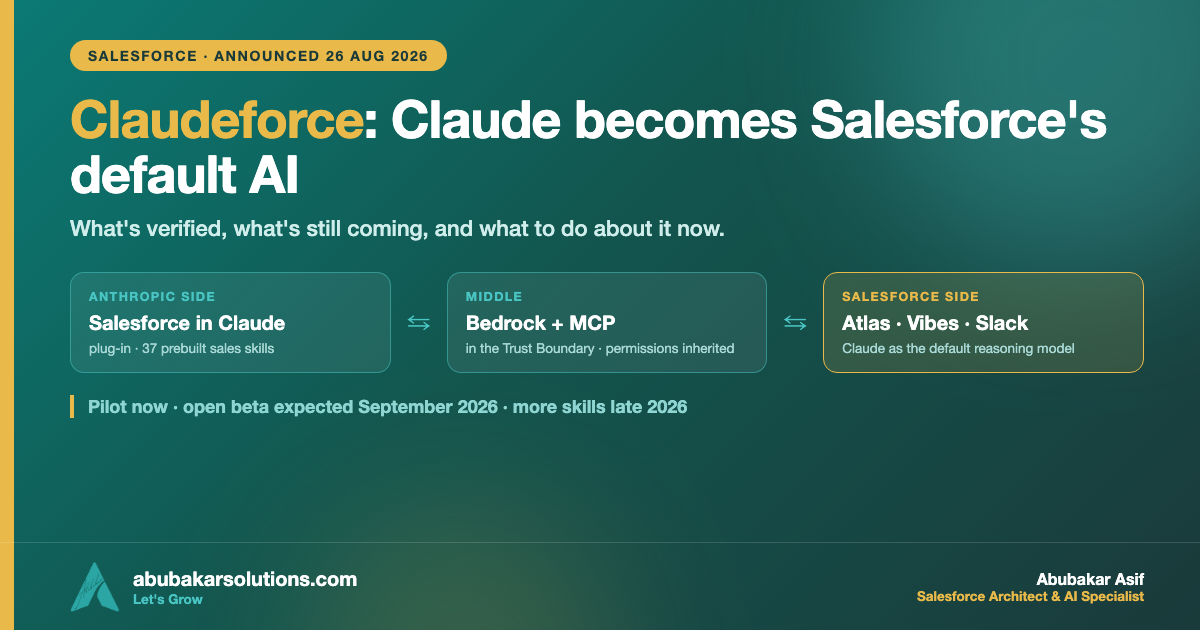
On 26 August 2026, Salesforce and Anthropic announced Claudeforce — and the headline everyone repeated (“the #1 AI meets the #1 AI CRM”) is the least interesting part of it. The interesting part is architectural: Claude moved into the Salesforce reasoning stack, and Salesforce moved into Claude as a plug-in. Two directions, one integration. I’ve spent the last day reading the actual releases rather than the summaries, because the summaries are already drifting. Here’s what is verified, what is genuinely new, and what it means for the org you’re responsible for.
What I’ll Cover in This Blog
✔️ Exactly what was announced — with dates and sources, not vibes
✔️ The two-way architecture, in one diagram
✔️ The trust model: MCP, permission inheritance, and the Salesforce Trust Boundary
✔️ What changes for admins, architects, developers and marketers
✔️ The licensing shift hiding underneath it
✔️ What I’d do in the next 90 days — and what I’d wait on
Now, let’s dive in. 🔥
What Was Actually Announced
Stripped of adjectives, from the Salesforce newsroom and Anthropic’s own post:
🔹 Claude is the reasoning model behind the Atlas Reasoning Engine in Agentforce, and it powers Agentforce Vibes and Agentforce Coworker by default. It is also available in Agent Builder.
🔹 Claude is the default for Slack AI and Slackbot — which matters more than it sounds, because Slack is where a very large number of employees actually work.
🔹 “Salesforce in Claude” is a plug-in inside Claude, launching with 37 prebuilt sales skills — meeting prep, deal health review, pipeline review — that let a seller reason over live revenue context and take governed action without opening Salesforce.
🔹 Claude runs inside the Salesforce Trust Boundary via Amazon Bedrock, with Anthropic describing itself as “the first LLM provider fully integrated within the Salesforce trust boundary” and Claude’s traffic contained within the Salesforce VPC — aimed squarely at financial services, healthcare, life sciences and other regulated industries.
🔹 Timing: select pilot customers now, open beta expected September 2026, additional prebuilt skills (beyond sales) beginning to launch late 2026.
Two corrections to the versions circulating: the extra skills are described as late 2026, not a specific quarter, and the 37 skills are sales skills — service, marketing and commerce are the follow-on wave. If you’re planning a roadmap around this, plan around those two facts.
Why This Is Bigger Than a Model Swap
Salesforce has offered model choice for years. If Claudeforce were only “Claude is now an option,” it would be a footnote. It isn’t, for three reasons.
🔹 Default is not the same as available. Whatever the model menu says, defaults decide behaviour at scale. The model wired into Atlas, Vibes, Coworker and Slackbot by default is the model that will answer the overwhelming majority of real questions in orgs that never change a setting — which is most orgs.
🔹 The direction reversed. Until now the pattern was “bring AI into the CRM.” Claudeforce also does the opposite: Salesforce becomes a surface inside somebody else’s AI client. A seller who lives in Claude can prep a meeting, review deal health and update the pipeline without the CRM UI. If that sounds familiar, it should — it’s the same architectural idea I wrote about in They Never Opened Salesforce, So I Brought Salesforce to Them. Claudeforce is Headless 360 with Anthropic’s client as the head.
🔹 The plumbing is MCP, and MCP is a standard. The connector reaching your org is the same Model Context Protocol I’ve covered in Connect Slack to Salesforce with Hosted MCP Servers. That means the skills, the security review and the mental model you build for Claudeforce transfer to every other MCP client you adopt later. This is not a one-vendor investment.
The Trust Model — Read This Part Twice
The single most consequential sentence in the whole announcement, for anyone with a security review to pass: the connector inherits your existing permissions. If a user can’t see an opportunity in Salesforce, they can’t see it through Claude either. And an admin connects the plug-in once, with authentication and permissions managed centrally — no per-user setup.
That is the correct design, and it’s the same principle I laid out in How to Secure Salesforce-Hosted MCP Servers: identity flows through, least privilege applies, and the platform’s governance fires regardless of which door the request came through.
But inheritance is not absolution. Three things to check before you switch it on:
✔️ Audit your profiles before you audit the AI. Inheritance means Claude gets exactly the access your users already have — including the over-provisioned permission set nobody has reviewed since 2023. Every “View All Data” you never cleaned up is now reachable in a chat window.
✔️ Decide the write list. Reading is reversible; writing isn’t. Be explicit about which objects the plug-in may update, and start narrow.
✔️ Know where the boundary sits. In-boundary via Bedrock is a genuine differentiator for banks, insurers and healthcare — but confirm which of your workloads actually run that way, because “available via Bedrock” and “your current tenant configuration” are different sentences.
What Changes, By Role
For admins. Central setup is the good news: one connection, permissions managed centrally, no per-user rollout. The work moves from provisioning to governance — which tools are exposed, which profiles reach them, and what your Event Monitoring is watching.
For architects. The design question stops being “which model?” and becomes “which surface should this work happen on, and what does the data underneath it look like?” A skill is only as good as the context it retrieves — which is why every hour spent on unified, current, permissioned data pays off twice here. If your Data 360 layer is thin, Claudeforce will make that visible fast. (That’s the whole argument of Data First, AI Second.)
For developers. Claude is the default in Agentforce Vibes — the Salesforce-native, AI-powered IDE experience for building, testing and deploying apps and agents — and in Agent Builder. Practically: the code-generation loop you already use gets a stronger default model, and the boundary between “build-time agent” and “runtime agent” keeps blurring.
For marketers. Be honest about timing. The 37 skills that shipped are sales skills. Marketing skills are part of the later wave. What’s safe to plan for now: campaign work shifting from clicking through screens toward directing agents over governed data, with segments, performance and overlap available as context in the same conversation. Design your data and taxonomy for that world now, because that’s the part that takes six months, not the part that takes a week.
The Licensing Shift Underneath
This is the strategic story nobody puts in the headline. Seat-based SaaS revenue has a natural ceiling — you run out of humans to license. Consumption-based agentic AI doesn’t have that ceiling, as long as each unit of consumption is producing value. Every announcement in this space, from every vendor, is quietly moving the revenue line from how many people you employ to how much work the agents do.
For you, that means two budgeting habits:
🔹 Instrument consumption from day one. Not after the first invoice surprises you.
🔹 Tie consumption to an outcome metric — cases resolved, pipeline updated, hours saved — so that “more usage” is a conversation about return, not just cost. That’s also the honest way to defend the programme internally.
What I’d Do in the Next 90 Days
1️⃣ Read your permission model, not the press release. One afternoon, one list: who can see what, who can write what. That list becomes your Claudeforce blast radius.
2️⃣ Pick one workflow, not a platform strategy. Meeting prep or deal health review. Narrow, high-frequency, easy to verify.
3️⃣ Get on the open beta list for Salesforce in Claude (expected September 2026) — but plan the pilot as a pilot, with a success metric and a kill criterion.
4️⃣ Fix the data the skills will read. Contacts, opportunities, activity history, entitlements. This is the work that decides whether the demo survives.
5️⃣ Wait on the marketing/service redesign. Those skills land later; designing around unreleased capabilities is how roadmaps get embarrassing.
Common Pitfalls
✔️ Treating “default” as “only.” Claude is the default across these surfaces; that’s a strong signal, not a lock-in decree. Keep your architecture model-agnostic anyway — I explain why in You Don’t Need a Bigger Model.
✔️ Skipping the permission audit because “it inherits permissions.” That sentence is a promise about the mechanism, not about your org’s hygiene.
✔️ Assuming skills mean no data work. Prebuilt skills assume clean, findable, current records. They don’t create them.
✔️ Rolling out to everyone at once because setup is central and easy. Easy rollout is not the same as ready org.
✔️ Planning marketing automation on a late-2026 promise. Build the data and taxonomy now; build the journeys when the skills exist.
Conclusion
Claudeforce is the clearest signal yet that the CRM is becoming something you talk to from wherever you already work, rather than a place you visit.
✔️ Verified: Claude powers Atlas, Vibes, Coworker and Slack by default; Salesforce is a plug-in in Claude with 37 sales skills.
✔️ Timing: pilot now, open beta expected September 2026, more skills late 2026.
✔️ The plumbing is MCP — so what you learn here transfers to every future AI client.
✔️ Permissions inherit — which makes your existing access model the security boundary, for better or worse.
✔️ Bedrock puts Claude inside the Salesforce Trust Boundary — the real unlock for regulated industries.
✔️ The economics are shifting from seats to consumption — instrument it early and tie it to outcomes.
The orgs that get value from this in 2026 won’t be the ones that switched it on first. They’ll be the ones whose data and permissions were ready when they did.
Wondering whether your org is ready for a Claudeforce pilot — permissions, data, and the one workflow worth starting with? Tell me what your team does all day and I’ll map it with you.
Which surface will your team actually use — Salesforce, Slack, or Claude? Tell me in the comments.
About the Author — Abubakar Asif
SALESFORCE ARCHITECT · AI SPECIALIST · CLOUD ARCHITECT · PAKISTAN
Abubakar Asif — Salesforce Solution Architect, AI & Cloud Specialist based in Pakistan
Abubakar Asif is a Salesforce Solution Architect and artificial intelligence, Google Cloud and CRM specialist based in Pakistan — a top-rated AI, cloud infrastructure and Salesforce expert, and a National AI Research Engineer. He began as a core member and AI researcher with Google Developer Group, known for AI-powered brain-state recognition research, then built AI models and the applications around them for STEM education with STEM Wizards Academia, Toronto.
TRUE AI PIONEER · PRE-GENAI ERA
Abubakar is not just an AI adopter — he is a researcher who built models before “AI” became a buzzword. Before ChatGPT, Claude, Grok or Gemini existed, he was training and deploying custom neural networks from mathematical first principles.
A turn toward Salesforce and AI made him a Solution Architect, which opened the rest: CTO at Sunshine AI, where he led the technology and architecture that earned the startup Salesforce Consulting Partner status and drove healthy partner revenue; consultant and lead roles across Australia, Indonesia, the United States and the United Kingdom; and CTO at Shift Financial Planning, building next-generation financial planning powered by AI and Open Banking APIs.
Today he is Chief Technology Officer at Kalala Consulting, leading AI, CRM and cloud architecture — Salesforce, Agentforce, Data 360, Google Cloud and Microsoft Azure — for clients across financial services, healthcare, education and other industries. He writes here at abubakarsolutions.com about Salesforce architecture, Agentforce and AI enablement, Google Cloud, and the data foundations that make all of it work.