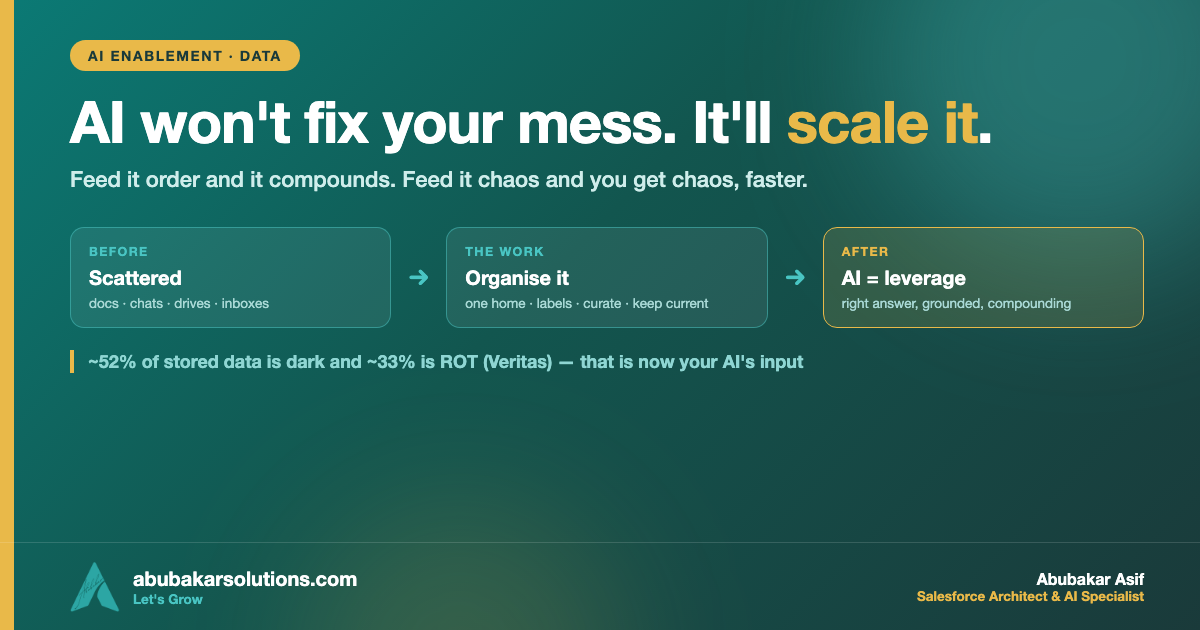
Everyone’s asking which AI tool to buy. Almost nobody asks the question that actually decides the outcome: is my information organised enough to use one? Because AI is a multiplier, and multipliers are indifferent to what you feed them. Point one at organised thinking and it compounds. Point it at chaos and you get chaos — faster, at higher volume, and delivered in a tone so confident that nobody questions it for three weeks. “Garbage in, garbage out” never went away. AI just gave the garbage better manners.
What I’ll Cover in This Blog
✔️ Why AI amplifies disorder instead of absorbing it
✔️ What the research actually says about how much of your data is usable
✔️ The four rules that turn raw information into AI fuel
✔️ What happens inside retrieval when two documents disagree
✔️ A one-week plan to get a knowledge base ready for AI
Now, let’s dive in. 🔥
The Scenario
Tarnwood & Co is a 90-person professional services firm. Their knowledge lives in three drives, two chat tools, a wiki nobody has curated since a 2024 rebrand, and roughly 400 email threads that contain the only record of certain client decisions.
They bought an AI assistant and pointed it at all of it. Week one was magic. Week three, a consultant sent a client a scope summary built on a superseded statement of work — because the drive contained SOW_final.docx, SOW_final_v2.docx and SOW_FINAL_signed.docx, and nothing anywhere marked which one won. The assistant didn’t pick wrong out of stupidity. It picked wrong because the mess was the input, and the mess offered no signal about which document was true.
The partner’s conclusion was “the AI isn’t reliable.” The accurate conclusion was: our filing system was never reliable — we just used to have humans quietly compensating for it.
How Much of Your Data Is Actually Usable? Less Than You Think
I see the “only 23% of enterprise data is usable” line quoted a lot. I couldn’t trace it to a primary source, so here are two figures that are traceable — and they tell the same story more credibly:
🔹 Veritas’ Global Databerg research found that roughly 52% of stored information is “dark” — nobody knows what’s in it — and another 33% is ROT: redundant, obsolete or trivial. That leaves around 15% identified as business-critical. (Veritas)
🔹 Seagate and IDC’s Rethink Data study found that only about 32% of data available to enterprises is put to work — the other 68% goes unleveraged.
Whichever number you prefer, the shape is identical: the overwhelming majority of what you’ve stored is noise, and until now that was merely wasteful. The moment you point retrieval at it, it stops being wasteful and starts being load-bearing — because retrieval has no opinion about which of those documents deserves to exist. It ranks by similarity, not by truth.
That’s the real change. Dark data used to be a storage bill. Now it’s an answer.
The Four Rules
Organising is not admin. It is the refining step that turns raw information into something a model can burn. Four rules, in the order they pay off:
1️⃣ One home per thing
When a fact lives in five places, AI mistakes repetition for consensus. Retrieval returns five chunks that all say the same slightly-different thing, the model reads that as strong signal, and now the most duplicated claim wins — regardless of whether it’s the correct claim.
Do this: pick the system of record per content type (contracts here, policies there, project decisions in one place). Everywhere else gets a link, not a copy. Copies are how truth forks.
2️⃣ Label it — a little metadata goes a very long way
Findability isn’t a folder structure; it’s metadata. What is this, who owns it, when was it last true, which product/version/client does it apply to, and who’s allowed to see it. Those five attributes are what let a retrieval layer filter before it ranks — and filtering is what stops the superseded document from ever entering the race.
Do this: define a small, boring metadata set and apply it to the content you’re actually indexing. Five fields consistently applied beat twenty-five fields applied to a third of the library.
3️⃣ Curate, don’t hoard
This is the one that meets the most resistance, because deleting feels dangerous and hoarding feels free. It isn’t free anymore. Feed a model two documents that conflict and you don’t get a flag — you get one fluent answer that blends both, with no seam and no warning.
Do this: for every content set you index, decide explicitly what is excluded: superseded versions, drafts, anything without an owner, anything past its review date. Exclusion is a design decision, and it’s the cheapest accuracy win available to you.
4️⃣ Keep it current
Stale content is a silent liability. A person reading a 2023 policy notices the date and hesitates. A model doesn’t hesitate — it doesn’t flag its own uncertainty the way a colleague would, and it will not tell you that the only document it found was three years old unless you engineered it to.
Do this: every indexed content type gets a review cadence and an owner. Past the review date, it either gets renewed or leaves the index. Automate the reminder; the discipline won’t survive on goodwill.
A One-Week Plan
You don’t need a knowledge-management programme. You need one week, one content set, and a finish line.
Day 1 — Pick one question the AI should answer. “What are our current terms for X?” Everything follows from a real question people actually ask.
Day 2 — Inventory only the content that answers it. Usually 40–200 documents, not the whole drive. Write down where each one lives.
Day 3 — Kill the duplicates. For each fact, pick the home. Everything else becomes a link or gets archived out of the index. This is the day that hurts and the day that matters.
Day 4 — Add the five metadata fields. Type, owner, effective date, applies-to, visibility. On the content you kept, not on everything you own.
Day 5 — Define exclusions and index. Superseded, draft, ownerless, past-review — out. Then index what remains.
Day 6 — Ask twenty real questions with known answers. Score them. Anything wrong traces back to a specific document decision, not to “the AI.”
Day 7 — Assign the review cadence. Who re-checks what, how often. Without this, you’ll repeat days 1–6 next year.
That’s it. One content set, one week, and every subsequent set gets faster because the rules already exist. For the CRM-record equivalent of this exercise — objects, fields, duplicates, freshness SLAs — see The 30-Day Data Foundation Sprint.
Common Pitfalls
✔️ Indexing everything because storage is cheap. Storage is cheap; wrong answers aren’t.
✔️ Treating this as an IT project. The people who know which document is current are the people who wrote it. This needs an hour of their time, not a tool.
✔️ Building a taxonomy before you have a question. Start with one question people actually ask; the taxonomy that emerges will be the useful one.
✔️ Confusing “we have it in SharePoint” with “it’s findable.” Storage is not retrievability.
✔️ Skipping the exclusion list. What you leave out determines your accuracy as much as what you put in.
✔️ Never re-testing. Content drifts. Re-run the twenty questions quarterly.
Conclusion
The model was never the bottleneck. The mess was.
✔️ AI is a multiplier — order compounds, chaos scales.
✔️ Most stored data is dark or ROT — ~52% dark and ~33% ROT in Veritas’ research; only ~32% put to work in Seagate/IDC’s.
✔️ One home per thing — duplication reads as consensus to a retrieval layer.
✔️ Label it — five boring metadata fields make filtering possible, and filtering beats ranking.
✔️ Curate, don’t hoard — conflicting documents produce one confident, blended, wrong answer.
✔️ Keep it current — a model won’t hesitate at a stale date the way a person does.
Organising isn’t the boring part you do before the AI project. In 2026 it is the AI project — the rest is configuration.
Sitting on drives and wikis nobody trusts, with an AI rollout waiting behind them? Tell me the first question you want answered and we’ll scope the week around it.
What’s the funniest wrong answer your AI has given from a stale document? Tell me in the comments.
About the Author — Abubakar Asif
SALESFORCE ARCHITECT · AI SPECIALIST · CLOUD ARCHITECT · PAKISTAN
Abubakar Asif — Salesforce Solution Architect, AI & Cloud Specialist based in Pakistan
Abubakar Asif is a Salesforce Solution Architect and artificial intelligence, Google Cloud and CRM specialist based in Pakistan — a top-rated AI, cloud infrastructure and Salesforce expert, and a National AI Research Engineer. He began as a core member and AI researcher with Google Developer Group, known for AI-powered brain-state recognition research, then built AI models and the applications around them for STEM education with STEM Wizards Academia, Toronto.
TRUE AI PIONEER · PRE-GENAI ERA
Abubakar is not just an AI adopter — he is a researcher who built models before “AI” became a buzzword. Before ChatGPT, Claude, Grok or Gemini existed, he was training and deploying custom neural networks from mathematical first principles.
A turn toward Salesforce and AI made him a Solution Architect, which opened the rest: CTO at Sunshine AI, where he led the technology and architecture that earned the startup Salesforce Consulting Partner status and drove healthy partner revenue; consultant and lead roles across Australia, Indonesia, the United States and the United Kingdom; and CTO at Shift Financial Planning, building next-generation financial planning powered by AI and Open Banking APIs.
Today he is Chief Technology Officer at Kalala Consulting, leading AI, CRM and cloud architecture — Salesforce, Agentforce, Data 360, Google Cloud and Microsoft Azure — for clients across financial services, healthcare, education and other industries. He writes here at abubakarsolutions.com about Salesforce architecture, Agentforce and AI enablement, Google Cloud, and the data foundations that make all of it work.